


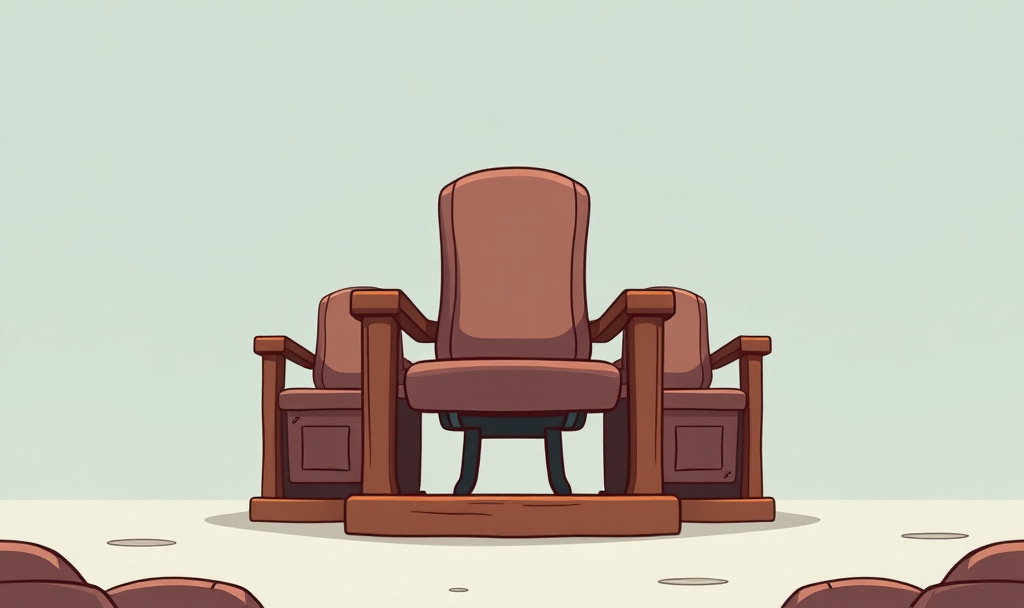
There is a question most institutions refuse to ask out loud:
How long is too long to hold a leadership seat?
And perhaps the more uncomfortable question:
Who gets to decide when someone’s time is up?
The people who have the power to answer that question are often the same people occupying the seats.
(Spicy, I know. But it’s time we talk about it.)
In academic medicine, leadership seats often remain occupied for decades.
Not because there are no capable successors, but because the structure of advancement was built in a different era of medicine.
Whether institutions want to acknowledge it or not, this conversation is already happening.
It happens in hallways.
In mentorship meetings.
In the quiet frustration of brilliant mid-career professionals who have been told, year after year, that their time is coming without anyone specifying when.
And while that frustration is real, something far more consequential is unfolding.
The generations expected to step into those seats Millennials and Gen-Z are quietly walking away from them.
Not because they lack ambition.
But because the system has spent two decades teaching them that the climb may not be worth it.
This is not a pipeline problem.
It is a warning signal.
And if institutions fail to hear it clearly, the workforce consequences will not simply be inconvenient.
They will be a generational crisis.
To understand why this is happening, we have to talk about the unspoken rules of institutional leadership.
The Workforce Dimension
Extended Tenure is a Structural Crisis
Both in academia and outside of it, senior leadership roles are increasingly defined by bottlenecks with fewer transitions.
Leadership turnover alone does not determine opportunity.
What matters is the bottleneck created when senior positions remain stable while the number of aspiring mid-career leaders continues to grow.
The once 8 to 10 year norm tenure has become a 15 to 25 year standard often without formal succession timelines, transition planning, or any structured mechanism for developing the leaders who will eventually need to follow. ( ie. Rep. Jim Clyburn)
Leaving the workforce to deal with the quietly compounding consequences.
When senior positions do not turn over, the vacancy signal that drives advancement disappears.
Indefinite holding patterns develop leaving talented professionals in their 30s and 40s in a time lurch where they are missing the essential leadership developmental window therefore unable to effectively build those needed skills.
They end up in the cycle where performing leadership-adjacent work is done:
Without leadership authority.
Without leadership compensation.
And without leadership visibility
Academic medicine offers one of the clearest illustrations.
Department chair tenures now frequently extend well beyond a decade.
Deanships span entire generational shifts in student demographics.
National professional associations often rotate governance among the same small cohort of senior leaders.
And while medicine offers a sharp example, this pattern is NOT unique to our field.
It is increasingly visible across nearly every major leadership sector in the United States.
Which means we should confront a problem few institutions are willing to address openly.
Until now.
As expertise and tenure continue to be rewarded, the systems designed to transfer knowledge, authority, and opportunity to the next generation of leaders have quietly eroded.
Studies of academic medicine leadership show that department chairs often serve for extended periods, with average tenures approaching fifteen years and documented ranges of more than three decades in some specialties. ( Read more here)
THE GENERATION THAT STOPPED CLIMBING
What Happens When the Pipeline Loses Faith in the Destination
For Millennials and Gen-Z, simply observing institutional leadership has been enough.
And what many have seen has changed their ambitions.
Institutions continue to assume that younger professionals are merely waiting their turn.
But that assumption is increasingly wrong.
Millennials and the generation behind them are not delaying leadership ambitions.
Many are walking away from them entirely and they are doing so because of what they have witnessed.
They watched talented predecessors spend a decade or more waiting for a seat that never opened.
They watched senior leaders hold power indefinitely while speaking at conferences about mentorship and succession.
They watched colleagues who did everything right:
Publish
Build credentials
Network
Serve
but still plateau in associate roles for years with no clear pathway forward.
And from those observations, many made a rational calculation:
The traditional leadership climb, in its current form, does not deliver what it promises.
Instead, it too often leaves people suspended in a kind of professional purgatory working within leadership structures without ever fully entering them.
But should young professionals expect leadership roles right out of the gate?
No. And most do not.
What they do expect are functional leadership pipelines systems that clearly demonstrate how leadership transitions will occur and who is being prepared to step into those roles.
Right now, those signals are often missing.
The path forward is rarely communicated, and even more rarely visible.
The result has been a quiet but significant workforce shift.
Across academia and healthcare, younger professionals are increasingly prioritizing :
autonomy over authority,
impact over title,
and flexibility over the kind of institutional loyalty that previous generations were expected to trade their best years for.
This is not a generational character flaw.
It is a rational response to a system that has repeatedly shown that the return on the investment of climbing is not what was advertised.
When institutions ask why they struggle to develop the next generation of leaders, the answer is often simpler than they expect:
The next generation watched the previous one wait and decided not to.
Younger professionals are not disengaged from leadership. They are disengaged from a version of leadership that asks for decades of deference in exchange for a seat that may never open.
Even when this reality is pointed out directly, it has not yet moved the previous generation to take meaningful action.
The question is why.
Do they believe the next generation is not equipped to lead?
Or do they believe their own leadership remains indispensable?
These are questions that deserve honest answers.
But while institutions continue to avoid them, the long-term workforce implications of this shift are already unfolding.
Academic medicine and healthcare institutions are facing mounting challenges: health equity crises, tightening research funding, declining public trust, and persistent workforce shortages.
And yet, at the very moment these pressures are intensifying, the pipeline of professionals willing and prepared to lead institutional responses is narrowing precisely when it should be deepening.
Institutions that fail to address the structural causes of this disengagement will not simply lose talent.
They will lose the next generation of visionary leadership at the exact moment it is most needed.
Why Trailblazers Feel They Cannot Leave — And What That Costs
When leaving means risking the very progress they fought to build.
For the generation of foundational, trailblazing leaders from underrepresented racial and ethnic groups, the tax is ongoing.
For many of these professionals individuals who achieved senior leadership often as the first in their institutions or fields the decision to step back carries a weight that their majority peers rarely face.
These leaders did not simply advance their own careers.
They opened doors for those who followed.
They shifted institutional cultures that had never before included them.
And in many cases, they served as the singular line of defense for equity-focused policies and practices.
In the current political environment marked by legal challenges to diversity programs, legislative attacks on equity initiatives, and the rapid dismantling of DEI infrastructure across higher education and healthcare many of these leaders have made a rational calculation:
Stepping back now could mean leaving behind progress that has no guaranteed successor and no meaningful institutional protection.
That fear is not irrational.
It is a reasonable response to a real threat.
But it carries a structural cost that compounds over time.
When trailblazing leaders remain in place without intentionally building and preparing successors who share their values and commitments, the progress they protect becomes entirely dependent on their continued presence.
The moment they step away for any reason the vacuum is real.
And it is often devastating.
Progress that depends entirely on one person’s presence is not institutionalized progress.
It is borrowed time.
And borrowed time, eventually, runs out.
The leaders who stayed to protect what they built, without building someone to protect it after them, may have delayed the very regression they feared.
The Succession Vacuum
When There Is No One Ready, Everyone Suffers
When a long-serving leader exits without a prepared successor, institutions enter a period of visionless organizational vulnerability.
This dynamic is well documented in management research and is immediately recognizable to anyone who has lived through it.
Decisions get deferred.
Vision goes unstated.
Junior colleagues who once relied on leadership for direction find uncertainty instead.
The new leader whether promoted internally or hired externally then spends their first one to two years learning what should have been transferred years earlier.
During that window, institutions are poorly equipped to navigate external pressures, respond to policy shifts, or retain the junior talent that needed leadership and instead found absence.
When this pattern occurs across multiple institutions at the same time, the cumulative effect becomes significant.
Without intentional succession infrastructure, leadership transitions produce a generational leadership deficit that can take decades to correct.
In academic medicine, that deficit is not merely inconvenient.
It is a crisis in slow motion.
The challenges facing these fields do not pause for leadership transitions.
Health equity does not wait.
Workforce diversity does not wait.
And the professionals who needed leadership to hold the line will not wait either.
They will leave for institutions that have it.
THE PATH FORWARD
I believe in action, not just analysis.
If institutions are serious about addressing the leadership transition crisis, structural change is required. And structural change means moving beyond aspirational conversations about mentorship and leadership development toward policies that actually produce successors.
Here are a few places to start.
Institutions should adopt term-limit frameworks for senior leadership roles, with structured transition periods of 18 to 24 months built into those timelines. Leadership transitions should be planned events, not sudden vacancies.
Succession planning should be embedded directly into senior leadership performance reviews. Developing future leaders should not be treated as a courtesy or an informal expectation. It should be measured, evaluated, and contractually expected.
Senior leaders from underrepresented backgrounds must be specifically supported in building successors who share their commitments to equity. That work requires institutional resources, time, and protection NOT personal sacrifice.
Mentorship accountability must also be redefined. The measure of mentorship should not be the number of hours spent advising junior colleagues, but the number of successors who are actually prepared and advanced into leadership roles.
Institutions must also build real leadership pipelines. Formal deputy and associate roles should exist with clear authority, visibility, and explicit timelines for advancement.
Leadership development programs must evolve as well. If institutions want Millennials and Gen-Z professionals to see leadership as worthwhile, programs must reflect the values that shape how these generations approach work: flexibility, purpose, autonomy, and realistic timelines to authority.
And finally, professional associations must examine their own leadership structures. Leadership tenure, demographic composition, and advancement patterns should be audited and publicly reported.
Without transparency, structural change rarely occurs.
What’s next?
The leadership transition crisis unfolding across academia and healthcare is not the result of individual failure.
It is the predictable outcome of institutions that have never treated succession as a strategic priority.
It is shaped by a political environment that has made stepping back feel like surrender.
And it is reinforced by a system that has spent an entire generation signaling to its most talented emerging leaders that the climb is not worth the wait.
Until those structures change, the seat will not simply remain full.
It will remain unwanted.
Want to read more The Dose by Faith Danielle MD ?
You have to subscribe!
Hit that button for more!