



If you’re a physician in training, start with the free guide:
Attending Money Is NOT a Plan
This short guide explains why waiting for attending income creates financial stress and what to build before that paycheck arrives.
The Myth No One Wants to Say Out Loud
Ready for a hard truth?
What if I told you that you are more likely to become a broke physician than a wealthy one?
That earning a medical degree, even from a top medical school, does not guarantee financial stability?
That a high school teacher has better odds at becoming a millionaire than an Ivy League top-10 medical school physician?
Fun fact — this is my story. A close friend became a teacher millionaire while I was the physician still figuring out money.
Not because physicians earn too little, but because no one teaches them how wealth works.
Medicine is often seen as a guaranteed path to financial success.
But income alone does not build wealth and many physicians are never taught how wealth is actually created.
The “Unofficial” Wealth Motto of Medicine
Most physicians have the same financial plan:
“I’ll figure it out when I’m an attending.”
It sounds reasonable.
Training is busy.
Money is tight.
Life feels temporary.
So money becomes something to deal with later.
Then attending life arrives and nothing else has changed.
No systems.
No habits.
No plan.
Just a bigger paycheck landing in the same unprepared account.
Attending money is not a financial plan.
Financial skills start during training.
Wealth in medicine isn't built by income.
It's built by systems learned during training.
If You’re a Physician in Training, This Is For You
Wealth Dose is for:
Medical students learning how money works for the first time
Residents and fellows building financial stability
First-generation physicians creating financial knowledge from scratch
Physicians who want to feel prepared before attending income arrives
Most physicians are never taught how money works.
Wealth Dose exists to make those conversations easier to start.
The Problem No One Teaches Physicians to Solve
Medical training teaches you how to diagnose disease and manage complexity.
It does not teach you how to manage money.
So many physicians finish training feeling uncertain about:
How to organize their money
How to build consistent habits
How to prepare for higher income
How to make financial decisions with confidence
Many physicians assume that earning more money will solve financial uncertainty.
But with more money, comes more problems, if you have no management skills !
But income alone does not create financial stability.
Systems matter.
And the best time to build systems is during training.
The Hidden Curriculum of Wealth in Medicine
In medicine, we often talk about the hidden curriculum the unwritten rules you learn to survive training.
How to navigate evaluations.
How to present yourself on rounds.
How to adapt socially and professionally.
But there is another hidden curriculum that almost no one talks about:
How to build sustainable wealth in medicine.
As a first-generation physician, I learned this the hard way.
No one told me that building financial systems during training mattered.
No one explained how money should be organized.
No one showed me what a financial system even looked like.
Like many trainees, I assumed wealth would come later when attending income arrived.
But what I eventually realized was that the physicians who feel most financially secure are not necessarily the ones who earn the most.
They are the ones who built systems early.
Wealth Dose exists to make this hidden curriculum visible.
What Wealth Dose Is
Wealth Dose is a space where we talk about personal finance skills for physicians in training.
Here we explore practical ways physicians can think about money from managing loan disbursements in medical school to beginning to invest during residency.
The goal is not to provide individualized financial advice.
The goal is to help physicians:
Understand how money works
Build financial confidence
Develop systems early
Feel prepared for attending income
Financial education during training makes the transition to attending life much easier.
The Wealth Dose System
Financial skills should match your stage of training.
At Wealth Dose, we talk about The Wealth Dose System financial systems that evolve with you:
Medical Students → Learn to manage money
Residents and Fellows → Learn to grow money
Because wealth is not built in one moment.
It is built step by step.
The Medical Student Wealth System
The Two-Account Foundation
Medical school is often seen as too early to think about money.
But medical school is the best time to learn how money moves.
Before investing and before retirement accounts, medical students can begin by building simple systems to manage cash flow.
One approach many students find helpful is organizing money into two types of accounts.
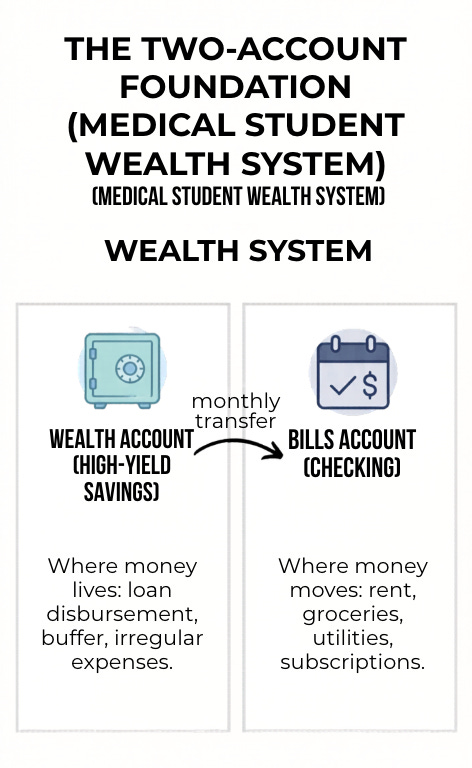
Wealth Account (High-Yield Savings)
This account can function as the primary place where money is held.
Loan disbursements or income may be deposited here whenever possible.
This account might hold:
Loan funds
Emergency buffer
Short-term savings
Irregular expenses
High-yield savings accounts allow money to earn interest while remaining accessible.
Many medical students keep large balances in checking accounts that earn little or no interest.
Learning how to organize money in savings early can help build financial awareness and confidence.
Bills Account (Checking)
A checking account can be used primarily for regular spending and bill payments.
Examples include:
Rent
Groceries
Transportation
Utilities
Subscriptions
Some students choose to transfer a planned amount from savings into checking each month to cover expenses.
This structure can help create:
Spending awareness
Better planning
Fewer surprises
More control over cash flow
Investing often becomes possible later in training.
Financial awareness can begin now.
The Resident and Fellow Wealth System
The Three-Account Engine
Residency and fellowship are often the first time physicians have consistent income.
With regular income comes the opportunity to begin building long-term financial habits.
Many residents and fellows choose to organize their finances into three general categories of accounts.
Bills Account (Checking)
This account can be used for everyday spending and routine bills.
Examples include:
Housing
Utilities
Insurance
Groceries
Transportation
Autopay expenses
Some residents keep enough here to cover about a month of expenses.
This helps keep daily finances predictable and organized.
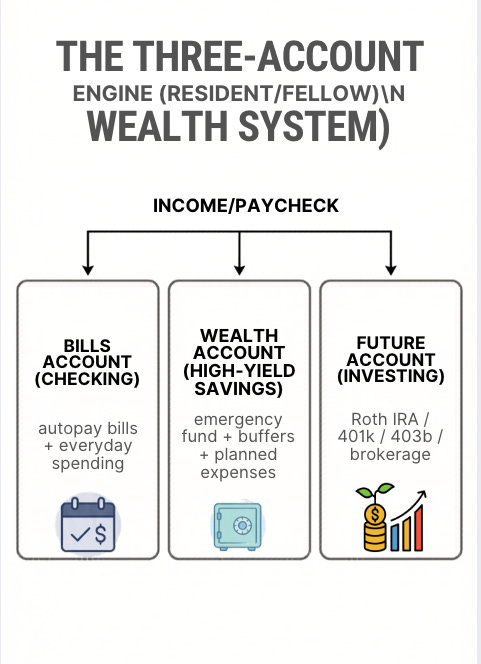
Wealth Account (High-Yield Savings)
This account may hold cash reserves and short-term savings.
Examples include:
Emergency funds
Planned expenses
Financial buffers
High-yield savings accounts allow cash to remain accessible while earning interest.
Savings can help protect financial stability during training.
Future Account (Investing)
Residency and fellowship are often when physicians begin learning about investing.
Examples of investing accounts include:
Roth IRA
Employer retirement plans
Brokerage accounts
Even small contributions during training can grow over long periods of time.
Learning about investing is often the next step after building stable cash-flow systems.
What Happens When You Build Systems Early
When financial systems are in place, money becomes less stressful.
You understand where your money goes.
You know what you can afford.
You make decisions more calmly.
Personally, having financial systems in place means I do not worry about the price of things in the same way.
I can enjoy the life I want to live in medicine without constantly second-guessing financial decisions.
And I can do that without relying on lifestyle creep or future income increases.
Financial systems create freedom long before attendinghood.
So where should you start?
Financial skills develop step by step.
You do not have to do everything at once.
Starting with one system is enough.
Step 1 — Learn the Core Idea
Start with the free guide:
Attending Money Is NOT a Plan
Download the Free PDF → Attending Money is NOT a Plan: Med Student Edition
Step 2 — Build Your First System
Choose the system that matches your stage of training.
Medical Students
Open a high-yield savings account
Use it as your primary account
Transfer planned spending into checking
Residents and Fellows
Separate bills, savings, and investing into three accounts
Learn how each account functions
Build consistency over time
Final Thought
The best time to learn money in medicine isn’t Attendinghood.
It’s NOW!
Attending Money Is NOT a Plan Guide
Don’t wait for attending money to figure out money.
Start with Attending Money Is NOT a Plan.
Get the free guide
Important Note
Wealth Dose is intended for educational purposes only and does not provide individualized financial advice. Financial decisions should be made in consultation with a qualified financial professional.